

Moving from Therapy to Coaching: The Transition That Changes Everything
Summary
Finishing therapy doesn’t always mean you’re finished growing. Counselling helps you process pain and stabilise; coaching builds direction and momentum once you’re steady. If your distress is low, your coping is solid, and you’re thinking more about goals than wounds, coaching may be the right next step. At One Team in Springfield, counselling and coaching integrate seamlessly — no provider switch, just forward progress.
Signs You’re Ready for transition to coaching
You’ve done the deep work.
You’ve unpacked the past. Learned your patterns. Built tools for anxiety, burnout, or relationship stress. Maybe it was through a GP Mental Health Plan. Maybe NewAccess. Maybe private counselling.
And now?
You’re stable. But you’re restless.
That’s the pivot point most people don’t talk about.
Therapy vs Coaching in Australia: What Actually Changes
Let’s make this simple.
Counselling (& Psychology) Australia
- Regulated professions
- Can diagnose and treat mental health conditions
- Focus on emotional healing, coping skills, stabilisation
- Often present- and past-focused
Coaching:
- Unregulated industry (no Medicare, no diagnosis)
- Future-focused
- Goal-setting and accountability
- Built for stable individuals ready to move forward
According to mainstream distinctions across Australian practitioners and organisations, therapy helps you heal and stabilise. Coaching helps you build and progress.
Different tools. Different focus.
Neither is “better.” They serve different stages.
The Real Question: Am I Ready to Transition?
Here’s what we’ve learned after working with our Springfield clients:
The transition isn’t about time.
It’s about stability and direction.
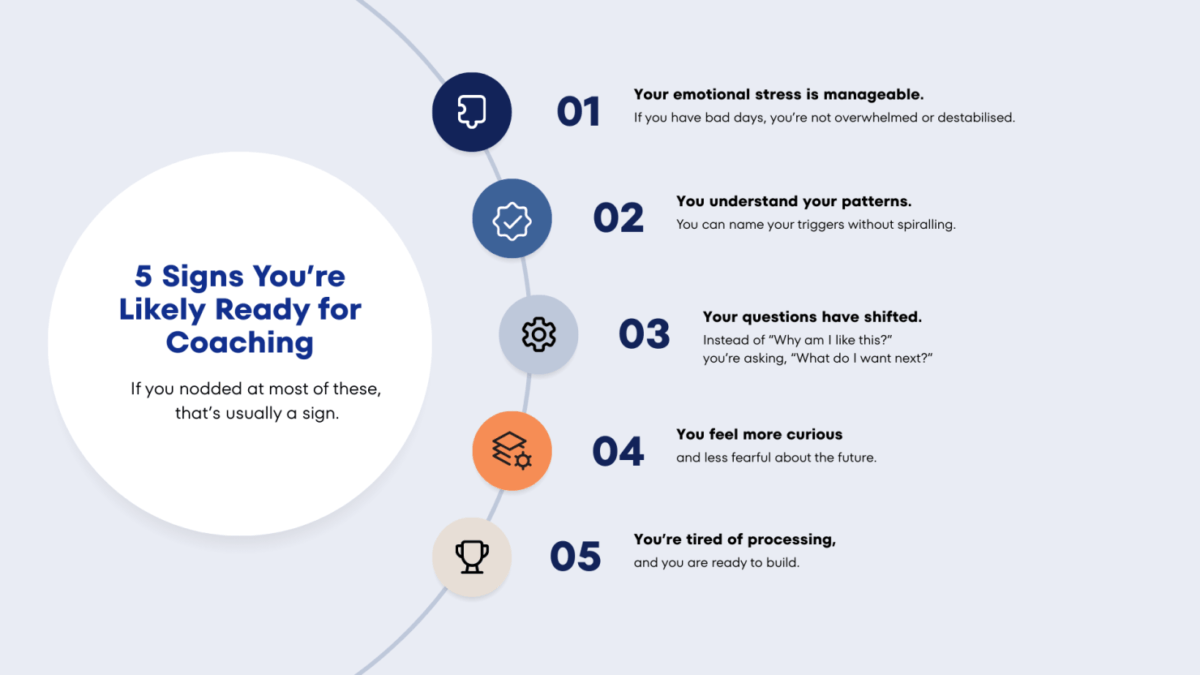
5 Signs You’re Likely Ready for Coaching
Read these slowly.
- Your emotional distress is manageable.
You still have bad days, but you’re not overwhelmed or destabilised. - You understand your patterns.
You can name your triggers without spiralling. - Your questions have shifted.
Instead of “Why am I like this?” you’re asking, “What do I want next?” - You feel more curious than fearful about the future.
- You’re tired of processing, and ready to build.
If you nodded at most of those, that’s usually the sign. Not perfection. Stability.
When Coaching Is Not the Right Step
This matters.
Coaching is not appropriate if:
- You’re in acute emotional distress
- Trauma is still destabilising daily life
- Anxiety or depression symptoms are unmanaged
- You’re using goals to avoid emotional work
Ethically, if instability shows up, you go back to counselling. No ego. No shame.
Forward movement only works when the foundation is solid.
What Actually Shifts: From Processing to Momentum
Therapy often asks:
- What happened?
- What does this mean?
- How do we reduce distress?
Coaching asks:
- Where are you going?
- What matters most now?
- What are you doing this week?
It’s subtle, but powerful.
Instead of unpacking pain, we design direction. Instead of insight alone, we build structured action. That might mean:
- Clarifying a career move
- Rebuilding confidence after burnout
- Designing healthier routines
- Strengthening leadership capacity
- Resetting relationship goals post-therapy
You’re not fixing yourself anymore. You’re building your next chapter.
How Coaching Complements the Therapy You’ve Already Done
Think of therapy as rehabilitation. Coaching is performance training.
Therapy builds resilience, coping, emotional regulation.
Coaching builds clarity, strategy, accountability.
They’re not competing models. They’re sequential stages, when timed well.
Even Beyond Blue’s NewAccess model reflects this idea: short-term mental health coaching supports early intervention and momentum once acute distress reduces.
Different names. Same principle.
Stabilise first. Then grow.
The One Team Hybrid Model: No Provider Switch, No Reset
Here’s where most people get stuck.
They finish counselling.
Then they have to start over with someone new for coaching.
Different relationship. Different backstory. Different explanation.
At One Team in Springfield, that gap doesn’t exist.
Because counselling and coaching can be integrated.
You don’t need to move on, but if you are feeling ready you can transition.
The emotional insight work (ACT, Gottman, foundational counselling tools) flows naturally into:
- Goal mapping
- Accountability rhythms
- Weekly action tracking
- Strategic clarity frameworks
Same practitioner. Same context. Different focus.
It feels seamless because it is.
What This Transition Often Looks Like in Real Life
When clients complete counselling with a focus on anxiety over 12-14 months.
By the end:
- Panic is often reduced or gone.
- Coping is stronger and easier.
- Relationships stabilise.
But even with wins like that it can fall flat of expectations.
It might feel like you are no longer “making progress”
and even though you are Not distressed, or feel like you need counselling There can often be a lack of direction.
The next step is to shift into coaching. Nothing dramatic.
Just forward momentum around wherever your life and goals have shifted – like:.
- Career changes
- Fitness routines to rebuild.
- Confidence talking to new people in public
- Or simply being more decisive or
- enforcing your boundaries politically firmly and proudly.
Therapy, Coaching, or Hybrid? A Simple Decision Guide
If this sounds like you, here’s the quick map:
| If You’re Experiencing | Start With |
| High distress, instability, trauma resurfacing | Counselling |
| Stable but stuck | Coaching |
| Some emotional work still needed + big goals forming | Hybrid transition |
And if you’re unsure? That’s exactly what an initial consultation or phone call is for. Here are some FAQs that a few past clients have asked about moving into coaching from counselling.
Can coaching help with work or relationships too?
Absolutely. Many clients use personal coaching to improve communication, confidence, and decision-making across all areas of life.
Can counselling and coaching be combined?
Yes. A hybrid model allows emotional processing and goal-building to happen together, transitioning gradually instead of abruptly.
When am I ready to transition from therapy to coaching?
You’re ready when emotional distress is stable, coping tools are working, and your focus has shifted from healing the past to building the future. Coaching requires stability, not crisis management.
What’s the difference between life coaching and counselling?
Counselling focuses on emotional healing and processing the past. Life Coaching is forward-focused, it’s about setting goals, taking action, and creating the future you want. Coaching is designed for building goals and momentum.
What if I’m not ready for coaching yet?
If anxiety, depression, or instability are still present, stay in counselling. Coaching works best when your foundation is steady.
What are signs I need coaching after anxiety counselling?
Signs include low distress, improved regulation, growing future curiosity, and a desire for clarity, accountability, and structured action.
Is life coaching covered by Medicare in Australia?
No. Coaching is not Medicare-rebatable and is not a regulated mental health treatment. It is designed for stable growth and goal development.
I’ve finished therapy — is coaching the next step?
Often yes, if you feel stable but stuck. If distress or trauma is still active, continuing counselling is the better choice. The transition depends on readiness, not time.
How does coaching complement therapy?
Therapy builds emotional insight and resilience. Coaching builds clarity, decision-making, and forward momentum. Coaching builds on therapy — it doesn’t replace it.
What Happens in Your First Coaching Session
It won’t feel like therapy.
You won’t retell your entire life story.
Instead, we clarify:
- What’s working
- What isn’t
- What you want 12 months from now
- What your next 30 days look like
Then we build structure.
Momentum isn’t accidental. It’s designed.
If You’re Not Ready Yet, That’s Okay
Sometimes people want to move forward because sitting still feels uncomfortable.
That’s different from readiness.
If counselling still has work to do, we continue it. There’s no rush.
The goal isn’t speed.
It’s sustainable progress.
The Quiet Truth About This Transition
Most people don’t need more insight.
They need direction.
After 12+ months of counselling, you often already know your patterns. You understand your emotional triggers. You’ve built regulation skills.
Now the question becomes:
What are you building? And who’s holding you accountable to it?
That’s where coaching fits.
If you’ve finished therapy and are wondering whether coaching is right:
- Book a short consult.
- We’ll clarify together.
- No guarantees. No pressure.
If coaching fits, we start building.
If counselling is still the right lane, we stay there.
Simple.
Therapy is often step one. Coaching might be step two. If you’re in Springfield or Ipswich and ready to explore that transition, book a conversation, online or in-person.

In this article